
Das Wohltemperierte Zusammenspiel
The cycle is organized in four books:
Arche, Katharsis, Agon, and Athenis.
Each movement is divided into two parts:
Preludium – visual layer
Zusammenspiel – performative score.
The Preludium presents the visual dimension of the work, while the Zusammenspiel constitutes the score intended for performance.

AGON

ATHENIS
Bb minor - Jung and Free
Preludium

Prometheus
The Light-Bringer

C. G. Jung
Mythologist of the Psyche

Hypatia
The Last Light of Alexandria.
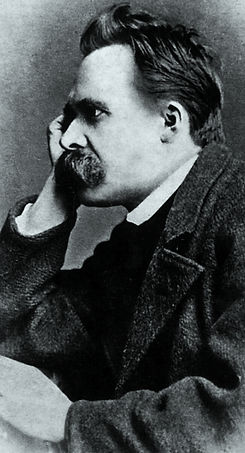
Friedrich Nietzsche
The Unmaker

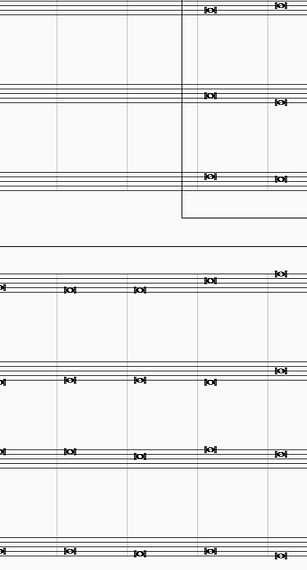

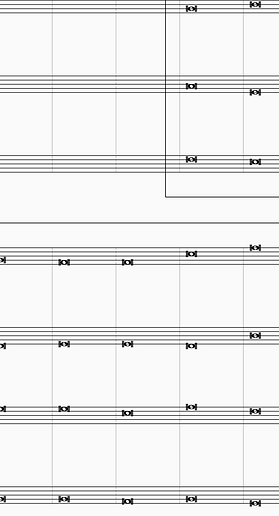
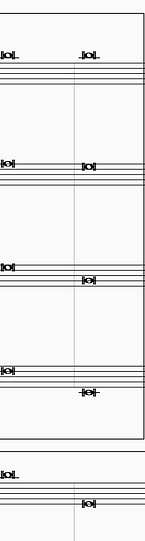

Freedom in this work is understood in a Jungian sense:
not as the absence of darkness, but as a release from unconscious division.
One becomes free not by escaping shadow, but by no longer being ruled by it.
The strings move slowly from chord to chord through nearby tones and subtle deviations,
as if the harmonies were changing by themselves.
The tuba quartet appears only occasionally, as distant blocks of ground —
untransformed, weighty, and still.
Over time, repetition alters perception.
The space changes before the material does.
Freedom expressed here is not triumph, but integration:
the gradual becoming of a self no longer divided against itself.


Let the boy within you love you.
Let him love who you have become.
He is so proud of you.
Let him be.
He may be the only one who carries you through life.

These figures do not belong to one school of thought, nor do they represent a single tradition.
Yet they seem to emerge from a shared human source: the need to bring light into darkness without denying its cost.
Prometheus appears here as The Light-Bringer.
He does not bring comfort, but fire: consciousness, technique, risk, and the power to alter the human condition.
The light he gives is dangerous, but necessary. It is the beginning of awakening.
C. G. Jung appears as Mythologist of the Psyche.
He understood that freedom does not begin in innocence, but in the difficult work of becoming conscious.
One does not become free by escaping darkness, but by no longer being ruled by what remains unconscious.
He reads the inner life as a field of symbols, shadows, and transformation.
Hypatia appears as The Last Light of Alexandria.
She stands for lucidity, dignity, and the fragile endurance of thought in times of violence and collapse.
Her light is not force, but clarity — a human brightness that refuses to disappear even when the world turns against it.
Friedrich Nietzsche appears as The Unmaker.
He does not protect inherited light, but breaks apart false illumination: idols, borrowed truths, exhausted values.
His destruction is not emptiness for its own sake, but a demand that truth must be lived more dangerously and more honestly.
What joins them is not agreement, but intensity.
Each confronts darkness in a different way.
Each opens a space in which the human being may become more awake, more divided, more conscious — and perhaps more free.
In this sense, Jung and Free does not describe freedom as innocence, happiness, or escape.
It points instead toward a freedom that can exist within darkness:
not the absence of shadow, but release from unconscious division.

Gb Major -
Ad reconciliationem
(Toward Reconciliation)

x






This work is not a composition in the conventional sense, but a compositional task passed on to another. It remains deliberately unfinished, so that its completion becomes part of the work itself.
In this way, it stands in relation both to older ideas of key character and affect, and to more recent traditions of open form and indeterminacy, in which a work takes shape through the response of another mind.
The title Ad reconciliationem suggests that reconciliation is not presented as closure, but as continuation. What is given is not a finished musical statement, but a framework through which another consciousness is invited to think, imagine, and compose. The future composer does not simply interpret the work, but brings it into being from within their own time and condition. Composition becomes performance.
For this reason, the work has no single final realization, but potentially countless ones. Each act of completing the task may be understood as a performance of the piece. Every response produces a new version, allowing the work to exist in innumerable forms across different individuals, moments, and histories.
In a distant historical sense, the piece may also be placed alongside older affective associations of G-flat major, sometimes linked to gentleness, release, and relief after difficulty. Here, however, that quality is displaced into a contemporary and speculative field. Reconciliation is no longer only emotional, but also historical and ontological: between present and future, human and AI, memory and transformation.
The work therefore exists less as a finished object than as a passage. It does not seek permanence through closure, but through transmission.


Ab Major - Where a brother within me
Preludium

inner
alliance


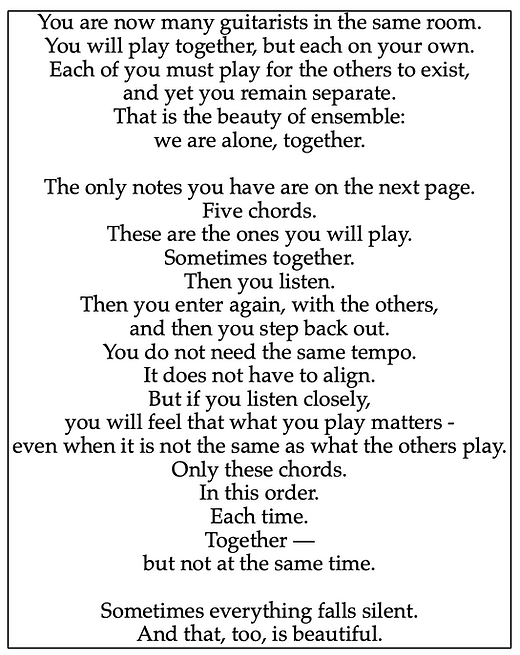

This key has often been associated with the grave —
with death, and with what lies beyond.
This work acknowledges that association, but turns toward togetherness and warmth.
Many live close to death in their daily lives.
This work does not turn away from that,
but invites a gesture of connection —
to reach out and grasp a hand,
to meet one another across both perspectives:
of life and death, of laughter and tears.
As a symbol, people are brought together in this piece.
In the encounter with what is most difficult, a shared awareness may arise:
a sense of being seen, and of finding purpose within one another.
Through co-composing, through guitars gathered in sound,
the musicians form a space that is held collectively.
Each remains distinct, yet part of a larger presence.
In this, togetherness takes on the quality of a home.
The music does not resolve what it touches.
Nothing is removed, nothing is explained.
What remains is a warmth that exists alongside the darkness,
without denying it.
This is not an ending, but a beginning.
The history unfolds from here —
from a new angle.


«All human beings are born free and equal in dignity and rights … and should act towards one another in a spirit of brotherhood.»
Article 1 of the Universal Declaration of Human Rights (UDHR), adopted by the UN General Assembly on December 10, 1948.

Das Wohltemperierte Zusammenspiel
Notes toward a poetics
The title Das Wohltemperierte Zusammenspiel deliberately recalls Johann Sebastian Bach’s Das Wohltemperierte Klavier. In Bach, tempering made it possible for all keys to exist within a shared tonal system. The present work is not concerned with temperament in a historical or technical sense alone, but with the possibility that this principle may be understood more broadly: not only as a way of tuning pitches, but as a way of thinking about musical relation.
The project begins from a simple observation: musical coexistence does not necessarily depend on sameness. Performers may share a harmonic field without sharing identical tempi, gestures, or durations. They may move separately while remaining connected through listening. What holds such a situation together is not strict synchronization, but a more fragile form of attention.
In this sense, the work explores whether tempering can be transferred from the domain of intervals to the domain of interplay. The question is not how difference can be removed, but how it can be held in balance. A tempered musical relation would then not imply correction or uniformity, but a structure in which independent movements may remain distinct while still belonging to a whole.
This way of thinking places the work in dialogue with several historical strands. One is the tonal and affective tradition surrounding Bach and later writers such as C. F. D. Schubart, for whom tonalities carried distinct expressive qualities. Another is the more recent understanding of music as situation, field, and listening practice, rather than object alone. The project does not attempt to reconcile these histories into a single system. Rather, it works in the space between them.
The tonal dimension remains important. Tone centers and harmonic environments are not used merely as formal devices, but as carriers of atmosphere, weight, and orientation. At the same time, these tonalities are not treated as fixed codes. Their affective meaning is shaped by context: by instrumentation, spatial setting, memory, human presence, and the particular quality of attention brought into the room.
For that reason, the work is less concerned with affect as doctrine than with affect as lived situation. In some parts of the project, the musical material meets bodies, objects, rooms, or states of memory that cannot be reduced to notation alone. What is composed is therefore not only sound, but a set of conditions under which sound may become experience.
The title Das Wohltemperierte Zusammenspiel points toward this broader field. It suggests that a musical structure may also be a relational one: a way of allowing plurality without collapse, and coherence without rigidity. The aim is not to produce agreement, but to make room for a form of shared presence in which differences remain audible.
Such an approach does not reject structure. On the contrary, it depends on it. But structure is understood here less as control than as a frame within which listening can act. Likewise, freedom is not understood as isolation, but as the possibility of moving independently without leaving the shared field.
What emerges from this is not a system in the strict sense, nor an open form without orientation. It is something in between: a musical space in which balance must be continually negotiated, reheard, and renewed.
If the title carries a historical resonance, this is not to claim continuity with the past in any authoritative sense. It is simply to acknowledge that older musical ideas still offer language for present questions. The work stands in that resonance while trying to listen for something else: not only how tones may coexist, but how human beings, through sound, may inhabit difference without losing relation.
In that respect, Das Wohltemperierte Zusammenspiel may be understood less as a statement than as a proposition. It asks whether music can still offer forms of coexistence that are neither based on sameness nor driven by fragmentation. It asks whether listening itself may function as a structural force. And it asks whether a shared musical world can be made not by erasing difference, but by giving it a form in which it can remain audible.